
5G-enabled XR live broadcasting of transoral robotic surgery (TORS): a feasibility study of an indoor small-cell architecture
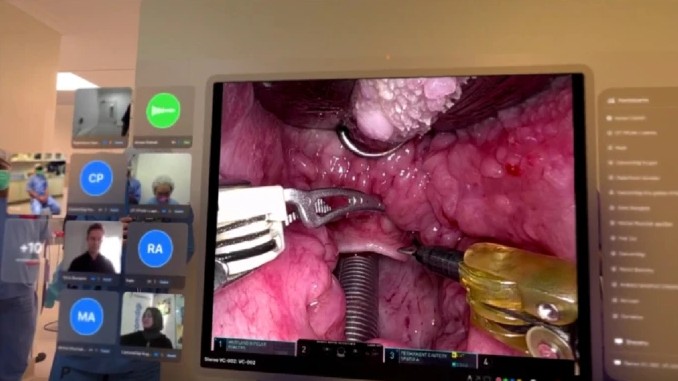
Image: Goh et al., Journal of Robotic Surgery (2026), CC BY-NC-ND 4.0
A surgical team at Universiti Malaya in Kuala Lumpur has shown that live robotic surgery can be streamed in three dimensions to Apple Vision Pro headsets around the world with almost no perceptible delay. The feasibility study, published in the Journal of Robotic Surgery in February 2026, broadcast a transoral robotic operation to remote viewers in seven countries at a measured latency of about 22 milliseconds.
The work is the first detailed description of an end-to-end pipeline that carries a robotic console view from the operating theatre, through a dedicated in-hospital 5G network, and onto extended-reality headsets, in a form other centres can reproduce.
How the broadcast worked
Video from a da Vinci robotic console was captured and processed in real time by the HoloStreamer device from apoQlar Medical, which applies hardware-accelerated GPU encoding and AI-based image enhancement to compress and sharpen the high-resolution feed. The processed stream was delivered to Apple Vision Pro headsets, giving remote viewers a stereoscopic, console-perspective view intended to reproduce what the operating surgeon sees, alongside standard flat-screen endpoints.
Why 5G is the enabling piece
The connectivity layer was the other half of the story, and arguably the harder one. A stereoscopic surgical stream is unforgiving: any stutter or lag in an extended-reality headset breaks the sense of depth and quickly makes viewers uncomfortable, so the network has to deliver high, sustained uplink throughput at consistently low delay. Hospital Wi-Fi and shared wired networks are rarely built for that. They are tuned for many small downloads rather than one large, steady upload, and they offer no guarantee that a live operation will not have to compete with routine hospital traffic at the worst possible moment.
The operating theatre is also one of the most hostile radio environments in the building. Reinforced concrete, metal fixtures and dense, electrically noisy equipment all attenuate and scatter wireless signals, creating dead zones exactly where a stable connection is needed most. Earlier long-distance 5G surgical demonstrations have shown low command latency but often higher video delay, precisely because the indoor leg of the link is so difficult.
This is where fifth-generation mobile networks change the equation. Compared with Wi-Fi or 4G, 5G New Radio offers far greater uplink capacity, lower scheduling latency, and the ability to carve out dedicated capacity for a single critical application. To make that work indoors, the team deployed a mid-band 5G New Radio small-cell system using 4x4 and 8x8 MIMO with beamforming, combining indoor and outdoor antennas to punch through the building’s attenuation. A dedicated Fixed Wireless Access gateway then distributed that capacity to the operating-room workstations and headsets over 5G and 5G Wi-Fi.
Crucially, the 5G layer was added on top of the existing hospital network rather than replacing it. That gave the broadcast a private, high-capacity uplink with its own headroom, so the live stream never had to fight routine hospital data for bandwidth, while supplementary devices could still connect for coordination without degrading the primary feed. The whole arrangement was built from commercially available 5G hardware, which is what makes it a realistic template for other hospitals rather than a one-off research rig.
What the numbers showed
The live segment ran continuously for 40 minutes with no interruptions, no equipment conflicts with clinical monitoring, and no safety concerns reported by the surgical team. A stop-broadcast protocol stayed available throughout.
Platform analytics recorded a mean latency of about 22 milliseconds across the session, far below the roughly 100 milliseconds at which experimental work shows telesurgical performance starts to degrade. Twenty remote participants joined from the United States, Bhutan, South Korea, Thailand, Singapore, the Philippines and Indonesia. Of the 14 who completed a System Usability Scale questionnaire, the mean score was 72, which the authors describe as acceptable usability for a single-session deployment.
The case
The index procedure was a transoral robotic lingual tonsillectomy in a 21-year-old patient with obstructive sleep apnoea, with the live teaching segment focused on the robotic tongue-base component. The patient recovered without complications, was discharged after a single night of observation, and reported improved choking symptoms and sleep quality at one-month follow-up.
Why it matters
For robotic surgery in particular, a stereoscopic console view matters, because the critical steps depend on depth cues and fine instrument-to-tissue interaction that a flat 2D stream flattens away. By preserving that depth on a headset, the approach narrows the gap between watching an operation and seeing it, which is the difference that makes remote mentoring and training genuinely useful.
Just as important, the authors built the whole pipeline from commercially available parts: 5G indoor radio infrastructure, an indoor FWA gateway, a dedicated AI-assisted hardware encoder, and an off-the-shelf headset. That makes the workflow a practical template for other hospitals that want to share surgical expertise across borders without laying new fixed infrastructure. The study received in-kind support from CelcomDigi, which deployed the 5G network, and from apoQlar Medical, which provided the software and the mixed-reality headsets.
The authors are careful about the limits: this is a single live session rather than a controlled trial, latency was a platform proxy rather than an independent glass-to-glass measurement, and there were no objective before-and-after learning outcomes. They call for multi-session studies with standardised video-quality metrics and knowledge assessments as the next step.
Source: Goh LC, Ong HY, Ab Zulkiflee MZ. “5G-enabled XR live broadcasting of transoral robotic surgery (TORS): a feasibility study of an indoor small-cell architecture.” Journal of Robotic Surgery (2026) 20:238. Read the open-access paper.
Comments
A static site cannot store comments itself. Connect a lightweight service such as Giscus (stores threads in a GitHub repo) or a hosted tool. See the README.